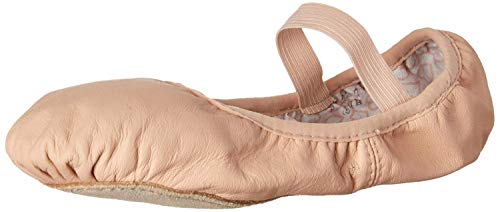
Ballet shoe sizing is model-specific. Start with the current chart for the exact listing, identify whether it uses child, women’s, men’s, or unisex sizing, choose an available width, and verify the result on both feet.
Identify the sizing system
Marketplace pages can mix toddler, little-kid, big-kid, women’s, men’s, and unisex scales. Read the selected variation—not only the page title—and confirm the chart belongs to that exact model. A conversion remembered from another brand or another model is only a clue, not an ordering rule.
Measure both feet
Measure heel to longest toe on both feet and note which is longer. Also record forefoot width and whether the toes are tapered or square. Measure in the tights, socks, or bare-foot setup used for class. If feet differ, start by safely accommodating the more demanding foot.
Choose length and width separately
Sizing longer to solve width can place the sole pads incorrectly and leave a heel pocket. Sizing shorter to stop slipping can curl the toes. When the maker offers widths, compare the correct length across adjacent widths. Otherwise compare a different last or model.
Create a reusable fit record
Write the brand, exact model, size system, size, width, color, try-on layer, date, and left/right observations. This is more useful than writing only ‘Capezio size 7.’ Recheck the live chart when reordering because sellers and model generations can change.
| Input | Record | Why |
|---|---|---|
| Scale | Child, women, men, unisex | Prevents wrong conversion |
| Length | Both feet | Feet commonly differ |
| Width | Maker code or option | Length does not replace width |
| Layer | Tights, socks, bare | Changes usable space |
| Model | Exact listing | Brand size alone is insufficient |
Questions dancers and parents ask
Are ballet sizes the same as street shoes?
Usually not; conversion varies by maker and model.
Should I order two sizes down?
Only if the exact current model chart says so.
What if I am between sizes?
Compare adjacent sizes when returns permit, then use the movement fit test.
Can an old pair determine a new size?
Only if brand, model, width, and sizing system are unchanged.
Continue the decision
Use the next page that matches the unresolved part of the decision. If a teacher’s requirement differs from this guide, the teacher’s rule wins.